Free printable log
The log that makes all your other logs mean something
Every temperature sheet in the building can record a number that is out of range. This is where you say what you did about it. Without it, a bad reading on a log is just written proof that you knew.
Free. No email, no account. Print it or fill it in on a tablet.
01Why this one matters
A number nobody acts on is worse than no number.
The log said 128°F and the pan stayed on the line.
Why this sheet exists
That is the whole argument. An unrecorded problem is a problem. A recordedproblem with no action beside it is written evidence that you saw it and carried on.
Your fridge log, cooking log and holding log all create that possibility every day. This sheet is where those moments get closed out properly.
02The counterintuitive bit
An empty log is bad news.
Most people assume a blank corrective action log is a clean bill of health. It reads as the opposite.
Six months with no entries means either nothing went wrong in half a year, or nothing got written down. Nobody has ever seen the first one. Real kitchens have a cooler that drifted, a batch that cooled too slowly, a delivery that arrived warm.
A log with a dozen entries — each one found, fixed and closed — is a far stronger document than a blank page. It shows a system that catches things.
03Filling it in
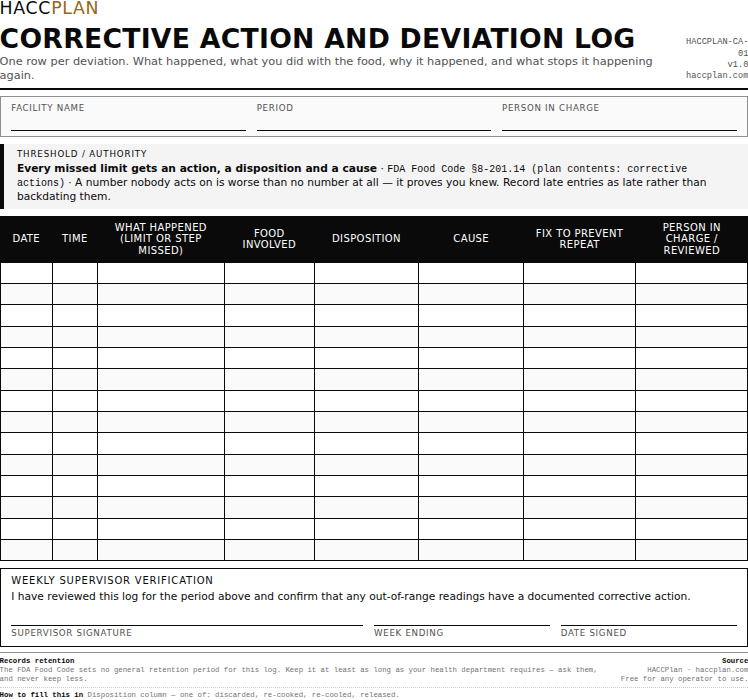
Four columns do the work.
- 1
What happened — name the limit that was missed
Not 'temperature issue'. 'Walk-in at 46°F at 07:00, limit is 41°F.'
- 2
Food involved — and how much
'4 kg chicken thighs, 2 pans of cooked rice.' This is what makes the entry checkable.
- 3
Disposition — what physically happened to it
Discarded, re-cooked, re-cooled, or released. One of those four words, then the detail.
- 4
Cause — the real one
'Door propped open during the 06:30 delivery.' Not 'cooler too warm', which is the symptom you already wrote in column one.
- 5
Fix — what stops it happening again
'Delivery moved to the side door; walk-in door not used for stock.' If you cannot write this, the same line appears next month.
04If you forgot
Late is fine. Backdated is not.
Something went wrong on Tuesday and nobody wrote it down. It is Thursday. What now?
Record it now, and mark it as a late entry. Then have the conversation about why it was missed. That is an honest record and it is completely defensible.
Writing Tuesday’s date on a Thursday entry is a different thing entirely. That is falsifying a record, and it turns a small lapse into a serious one.
05Getting it wrong
What an inspector notices.
No entries at all
Reads as a kitchen that does not record problems, which makes every other log look less reliable.
A bad reading on the fridge log with nothing here
The two sheets contradict each other. One says something happened, the other says nothing did.
Cause and fix left blank
Without them the log is a list of incidents rather than a record of a system that improves.
The same entry every month
It shows the cause was never actually addressed — the log became the routine instead of fixing it.
06Questions
The things people ask.
What counts as a deviation?
Anything where a limit or a step in your plan was missed. A cooler over 41°F. Chicken that came off at 158°F. A cooling batch still warm at two hours. A cleaning task that did not happen. If one of your other logs recorded something out of range, it belongs here too.
My log is empty. Isn't that good?
No, and this is the part worth understanding. Six months of nothing means one of two things: nothing ever went wrong, or nothing ever got written down. Inspectors have never seen the first one. An empty log reads as a kitchen that is not recording, which makes every other log look less trustworthy.
What do I put in the disposition column?
What physically happened to the food. Discarded, re-cooked, re-cooled, or released. Be specific — 'discarded 4 kg chicken thighs' is a record, 'sorted' is not.
Do I really need the cause column?
It is where the value is. 'Cooler too warm' tells you nothing. 'Cooler at 46°F because the door was propped open during the delivery' tells you exactly what to change, and next month you will not be writing the same line again.
I forgot to write one down at the time.
Record it now and mark it as late. That is honest and defensible. Backdating it is falsifying a record, which is a much bigger problem than a late entry ever was.
Who signs it?
The person in charge at the time records it. Someone reviewing later signs it off. If those are the same person on every line, nobody is really checking.
Print it and keep it at the front of the binder, not the back. It is the sheet you reach for on a bad day.
Anything out of range on the fridge, cooking or holding logs should end up with a line on this one.