Free printable log
The fridge log, and how to fill it so it actually counts
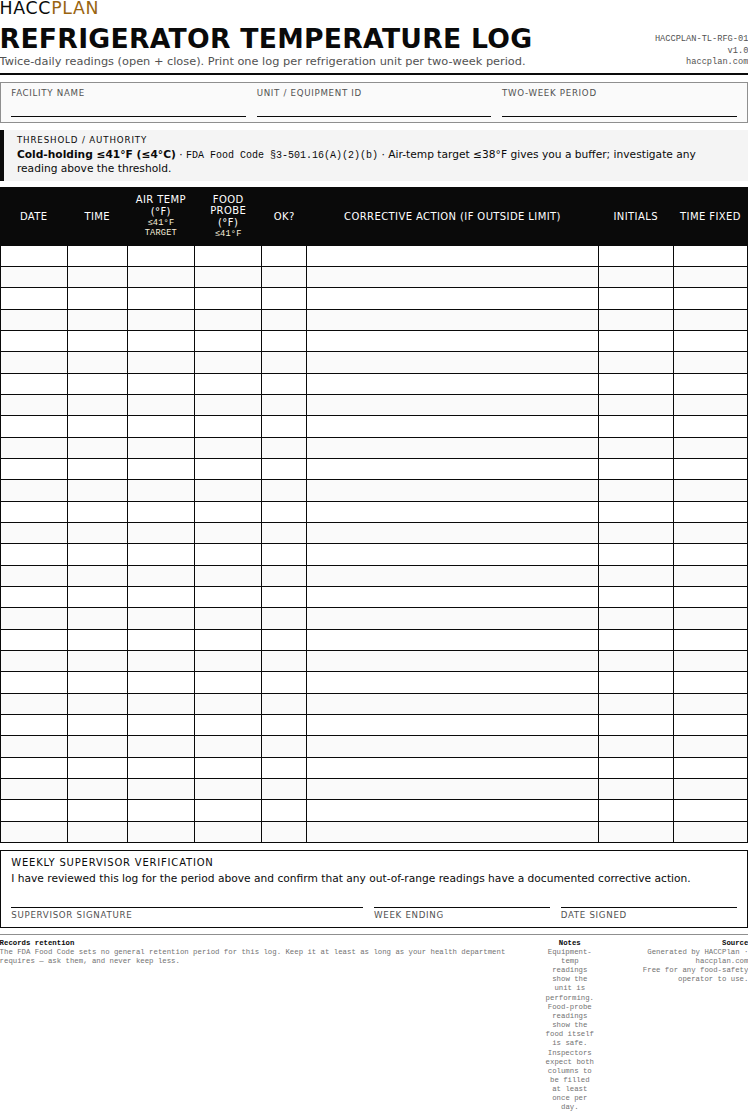
Two readings a day, fourteen days to a page, one page per cooler. It takes about twenty seconds to fill in. Here is what each column is for — including the two that most people leave blank, which are the two an inspector reads first.
Free. No email, no account. Print it or fill it in on a tablet.
01Why this sheet exists
A cooler can fail quietly.
A fridge does not bang or smoke when it starts to go. It drifts. It sits at 45°F over a long weekend while the door stays shut and everything inside looks completely normal on Monday morning.
That is the whole reason for this piece of paper. Somebody reads the number twice a day, so the drift gets caught on the first shift instead of after a week of food has gone through it.
Cold food has to be at 41°F (5°C) or below.
FDA Food Code §3-501.16(A)(2)(b)
Shell eggs are the exception — they can sit in air at 45°F. Everything else on your cold list works to 41°F.
02Before you write anything
Put the thermometer in the warm spot.
Every unit needs its own thermometer, and where you put it changes what you learn. Put it near the door, on the top shelf. That is the warmest part of the cooler.
A thermometer tucked in the coldest back corner gives you a lovely number that is true about the thermometer and false about the food. If the warm spot is at 41°F, everything else is colder. That is the reading worth writing down.
03The two columns people skip
Air temperature is not food temperature.
The sheet has a column for air and a column for a food probe, and they are asking two different questions.
Air temp tells you the unit is working. It also swings fast — open a door during service and the air jumps, then settles within minutes.
Food probe tells you the food is safe. A tub of soup does not warm up in the two minutes a door was open, and it does not cool down quickly either. When the air reading looks wrong, the probe is what tells you whether you have a real problem or just a busy door.
You do not need to probe food every single time. You do need to probe it any time the air reading is above 41°F — and then write both numbers down.
04When a number is bad
What to do, in order.
A high reading is not a failure. Not writing down what you did about it is. Work down this list and put the result in the corrective action column.
- 1
Probe the food, not the air
The unit says 44°F. That does not yet tell you the food is unsafe. Put a clean, calibrated probe into something dense in the middle of the unit and read it.
- 2
Food is 41°F or below? Fix the unit and check again in an hour
Close the door properly. Clear whatever is blocking the vents. Call for service if it is not obvious. Then re-read in one hour and log that reading too.
- 3
Food is above 41°F and you do not know for how long? Throw it out
This is the hard one. If you cannot show how long it has been warm, you cannot show it is safe. Discard it and write down what you discarded.
- 4
Above 41°F but you know it has been under 4 hours? Move it
Move it to a unit that is working and re-check. Four hours is the limit, and the clock includes the time you have already spent finding out.
- 5
Write the reading and the action on the same line
Both. The reading proves you looked. The action proves you did something. A high number with an empty box beside it is worse than no log at all.
05Once a week, somebody senior
Checking the log is a separate job.
Filling the log in is one job. Checking it is another, and it belongs to someone else — a manager, the owner, whoever is named in your plan.
They read the week, look for blanks and for high numbers with nothing written beside them, and they test the unit’s own thermometer against a calibrated probe. The two should agree within 3°F. If they do not, the thermometer has been lying to you all week and every reading above it is worth nothing.
06Getting it wrong
What an inspector notices.
A perfect log
Fourteen days, twenty-eight readings, not one of them off and not one blank. Real coolers drift. A flawless sheet reads as filled in on Friday afternoon, and inspectors have seen thousands of them.
A high reading with an empty box beside it
You have written proof that you saw a problem and no proof that you did anything. This is worse than not logging that day.
One sheet for four coolers
When a reading is high, the sheet cannot show which unit was warm — so it cannot show you fixed the right one.
No initials
A record nobody signed belongs to nobody. Initial every line you fill in.
07Questions
The things people ask.
How often do I have to check the fridge?
Twice a day is what most kitchens do, and it is what this sheet is built for — once when you open and once when you close. The Food Code does not name a number. It says the food has to be at 41°F or below, and twice a day is usually enough to prove it and to catch a unit that is failing before you lose the food inside.
Do I need a separate sheet for every fridge?
Yes. One sheet per unit, with the unit's name or number written at the top. A single sheet covering four coolers cannot show which one was warm, so it cannot show you fixed the right one.
How long do I keep the finished sheets?
The FDA Food Code does not set a general retention period for this log. Your health department does. Ask them, write the answer down, and never keep less than they ask for. Many kitchens keep a rolling year because the binder is easy to store.
The Food Code says 41°F. Why does the sheet say aim for 38°F?
38°F is not a rule. It is a cushion. A cooler sits a little warmer every time the door opens, so a unit running right at 41°F goes over the limit during a busy service. Aiming for 38°F means the normal swing still leaves you legal.
Is a temperature log actually required by law?
The Food Code requires the food to be cold. It does not, in general, require you to write it down. The log is how you show an inspector that it was cold when nobody was watching — and most health departments will ask to see one. Some local codes do require records, so check yours.
What about shell eggs?
Shell eggs are the one common exception. They may be held in air at 45°F rather than 41°F [Food Code §3-501.16]. Everything else on your cold list works to 41°F.
Print one per cooler, write the unit name at the top, and put it on a clipboard on the door. That is the whole system.
If you are building a full food safety plan, this log comes out of it already listing your units, with your check times and the person responsible filled in. See how that works.