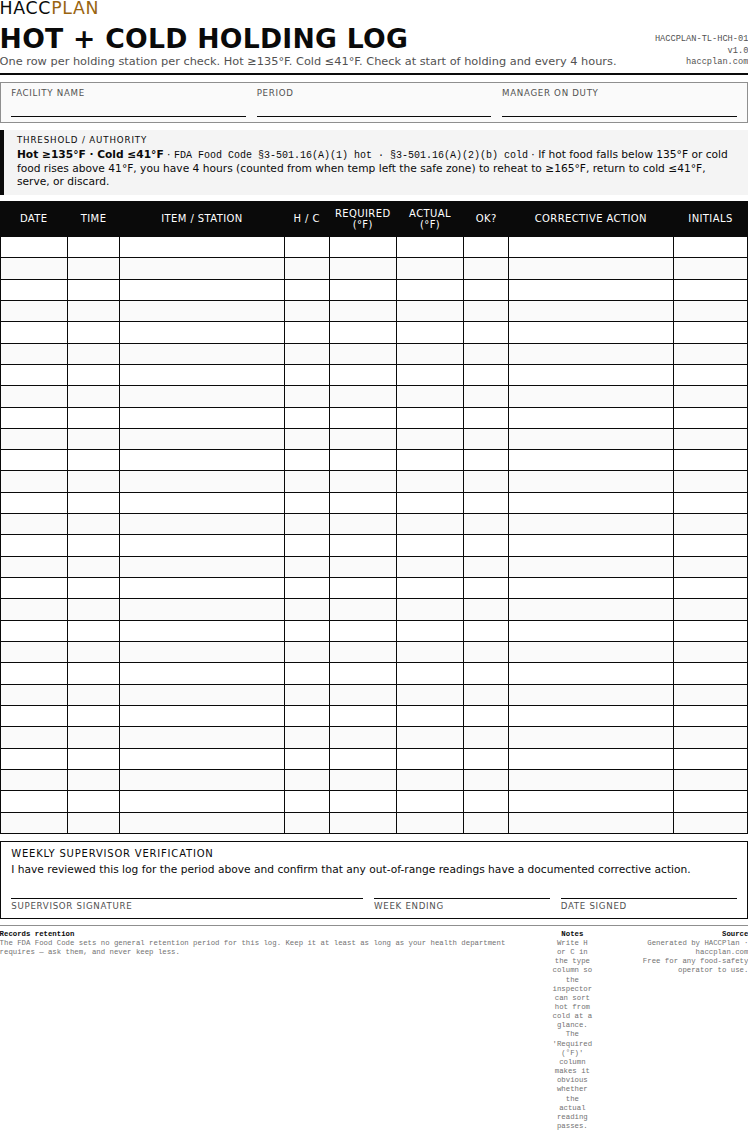
Free printable log
The holding log — and why the last reading decides everything
Hot above 135°F, cold below 41°F, checked through service. Simple enough. But the real value of this sheet is what it lets you do when a reading comes back low, and that depends entirely on the reading before it.
Free. No email, no account. Print it or fill it in on a tablet.
01The rule
135 and 41, at all times.
Hot: 135°F or above. Cold: 41°F or below. At all times.
FDA Food Code §3-501.16
Not on average, and not most of the time. Whole roasts cooked under the roast table are the one exception, and may be held at 130°F.
Most kitchens check every two hours. That is a sensible default rather than a legal one — it leaves room inside the four-hour window that decides what happens next.
02Why the sheet matters
Your last reading is what saves the food.
Here is the part worth understanding properly, because it is worth real money.
A tray of rice on the pass reads 128°F. What happens to it depends on one thing: can you show when it was last in limit?
If the log says it was 141°F ninety minutes ago, you are inside four hours. Reheat it to 165°F for 15 seconds and it goes back out. If there is no previous reading — or the last one was this morning — you cannot show how long it has been down there, and it is a discard.
Same tray. Same temperature. The only difference is whether somebody wrote a number down two hours earlier.
03Doing it right
Preheat, stir, probe the food.
- 1
Preheat the unit before anything goes in
A steam table needs water in the well and about half an hour to come up. A hot box for transport gets preheated before it is loaded.
- 2
Put food in already at temperature
Holding equipment holds. It does not cook, and it does not rescue. Cold food going into a steam table travels slowly through the worst possible range.
- 3
Stir before you probe
An unstirred pan is cool on top and hot underneath. Stir it, then read the middle.
- 4
Probe the food, never the water or the air
The water in the well is not what anyone is going to eat.
- 5
Write the number and the time, every time
The time is half the record. Without it the previous-reading rule does not work.
04Getting it wrong
What an inspector notices.
A four-hour gap on a sheet that says two-hourly
Your own plan sets the interval. Missing it is measured against what you wrote, not against the Code.
A low reading with nothing written beside it
The sheet proves you saw it. The blank proves nothing happened next.
Cold food logged going into hot holding to warm up
It tells an inspector the kitchen is using holding equipment to cook, which raises questions about everything else.
One line for a whole buffet
When something is low, the sheet cannot say which dish — so it cannot show the right dish was dealt with.
05Questions
The things people ask.
What are the holding temperatures?
Hot food stays at 135°F or above. Cold food stays at 41°F or below [Food Code §3-501.16]. Both of those are 'at all times', not on average. Whole roasts cooked under the roast table are the one exception and may be held at 130°F.
How often should I check?
Every two hours is what most kitchens settle on, and it is not an accident — it leaves you room inside the four-hour window if something has gone wrong. Whatever interval you pick, write it in your plan and stick to it, because gaps longer than your own stated interval are what get noticed.
Food is below 135°F. Do I have to throw it out?
Not necessarily, and this is where the log earns its keep. If your previous reading shows it was in limit less than four hours ago, reheat it to 165°F for 15 seconds and put it back. If you cannot show when it dropped, or four hours have gone by, it goes in the bin.
Can I bring cold food up in the steam table?
No. Holding equipment holds; it does not cook. Food goes in already at temperature. Trying to bring something up in a steam table walks it slowly through the exact temperature range you are trying to avoid.
Where do I put the probe?
In the food, in the middle, after stirring. Not in the water bath and not in the air. An unstirred pan is cold on top and hot at the bottom, and neither number is the real one.
One line for the whole buffet?
One line per item. When a reading is low, a single line for eight dishes cannot show which dish was the problem.
Print it, keep it at the pass, and write the time next to every number.
Food heading into the cooler instead needs the cooling log.