Free printable log
The cooling log, and the two hours that matter most
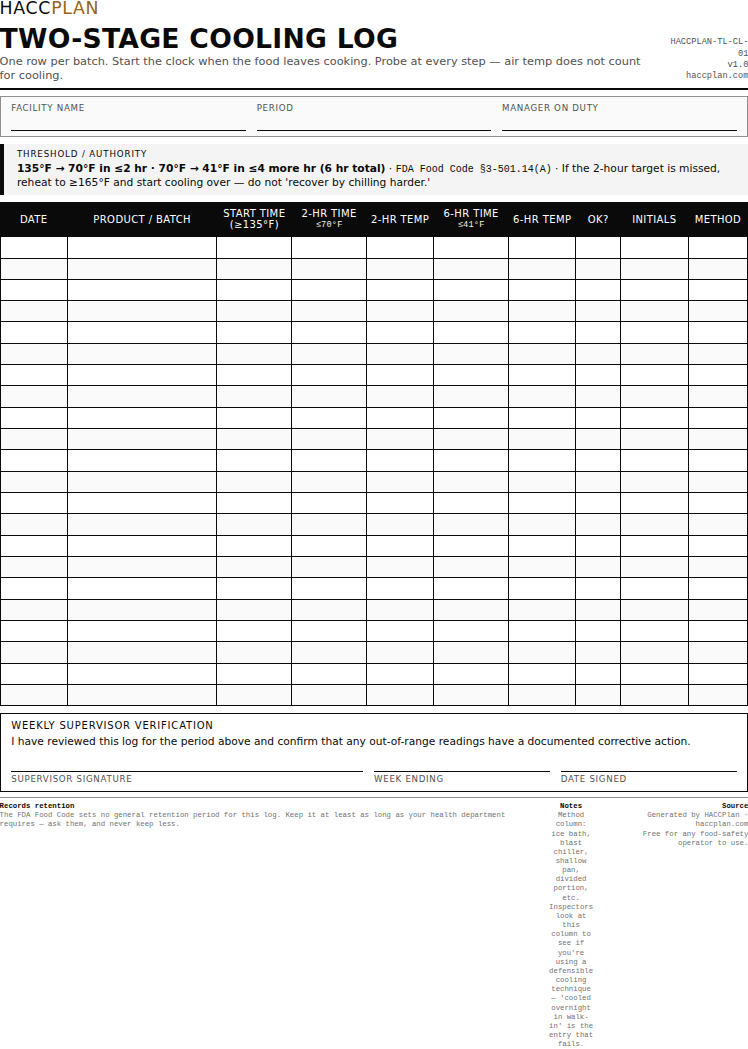
Cooling is the step that goes wrong more often than any other, and it goes wrong quietly. This sheet has two checkpoints on one clock. Here is what each one is really asking, and what to do when you miss the first.
Free. No email, no account. Print it or fill it in on a tablet.
01The rule
Two checkpoints. One clock.
135°F down to 70°F within 2 hours. Then all the way to 41°F within 6 hours total.
FDA Food Code §3-501.14
The six hours includes the first two. Miss stage one and you have not bought yourself more time later — the clock kept running.
Almost all the risk lives in that first two hours. Between 135°F and 70°F the food is passing straight through the range bacteria like best, and the longer it lingers there the more of them there are at the end.
Food you made cold from room-temperature ingredients — tuna salad from a can, cut melon, anything reconstituted — has its own clock: down to 41°F within 4 hours of making it.
02The entry that fails
“Cooled overnight in the walk-in.”
If an inspector reads one thing on your cooling log, it is the method column. And this is the entry that ends the conversation.
A walk-in is designed to hold food cold. It is not designed to pull the heat out of a six-inch-deep tub of chili. Put that tub in whole and it will still be well above 70°F two hours later — and you will have no way of knowing, because it looked fine and the cooler was doing its job.
The fix is always the same idea: make the food thinner or smaller so the heat has somewhere to go.
03Methods that work
Give the heat a way out.
- 1
Shallow pans
Two or three inches deep, uncovered until it is cold. The single easiest change most kitchens can make.
- 2
Split the batch
One big container becomes four small ones. Four times the surface, a fraction of the time.
- 3
Ice bath
Pot into a sink of ice and water, up the sides, stirred. Works fast for liquids and sauces.
- 4
Ice paddle
A frozen paddle stirred through the pot. Cools from the inside, which is where the problem is.
- 5
Blast chiller, if you have one
Purpose-built. Still write the readings down — the machine does not sign your log.
04When you miss it
One reheat. Then it is a decision.
Still above 70°F at the two-hour check? Reheat it to 165°F for 15 seconds right away and start cooling again with a faster method. You get that once.
Above 41°F at six hours, or you cannot say when cooling actually started? Throw it out. There is no third option, and the log is what tells you which of those two situations you are in.
Write down the batch, both readings, the method and what you did.
05Getting it wrong
What an inspector notices.
The method column is empty
Without it the log shows temperatures dropped but not that you used a technique that could defend them.
'Walk-in' written as the method
It tells an inspector the kitchen thinks a cooler is a chiller. Expect follow-up questions about everything else.
A 6-hour reading with no 2-hour reading
The first stage is where the risk is. Skipping it means the entry proves almost nothing.
A reheat with no note
You are allowed one recovery attempt. Undocumented, it looks like an ordinary reading — or like a second attempt.
06Questions
The things people ask.
What is the two-stage cooling rule?
Hot food has to drop from 135°F to 70°F within 2 hours, and then all the way down to 41°F within 6 hours total — the 6 hours includes the first 2 [Food Code §3-501.14]. Two checkpoints, one clock.
Can I cool it overnight in the walk-in?
No, and this is the single most common failed entry on a cooling log. A walk-in is built to hold food cold, not to pull heat out of a deep tub. A big container of chili put straight in will still be well above 70°F two hours later.
What actually works?
Make the food shallower or smaller: shallow pans a few inches deep, split a big batch into several containers, an ice bath around the pot, an ice paddle stirred through it, or a blast chiller if you have one. Anything that increases surface area.
I missed the 2-hour mark. Now what?
If it is still above 70°F at 2 hours, reheat it to 165°F for 15 seconds straight away and start cooling again using a faster method. You get that once. If it is above 41°F at 6 hours, or you cannot say when cooling started, throw it out.
What about things I make cold, like tuna salad?
Different clock. Food made from room-temperature ingredients — canned tuna, reconstituted powder, cut melon — has to reach 41°F within 4 hours of being made.
When does the clock start?
When the food comes off the heat, not when someone remembers to write it down. Write the start time as you put it down, not afterwards.
Print it, keep it by the stove, and write the start time as you put the pan down.
Cooked food that goes straight to service needs the cooking log instead, and food waiting on a line needs the holding log.