Free printable log
Cooking temperatures, and the log that proves you hit them
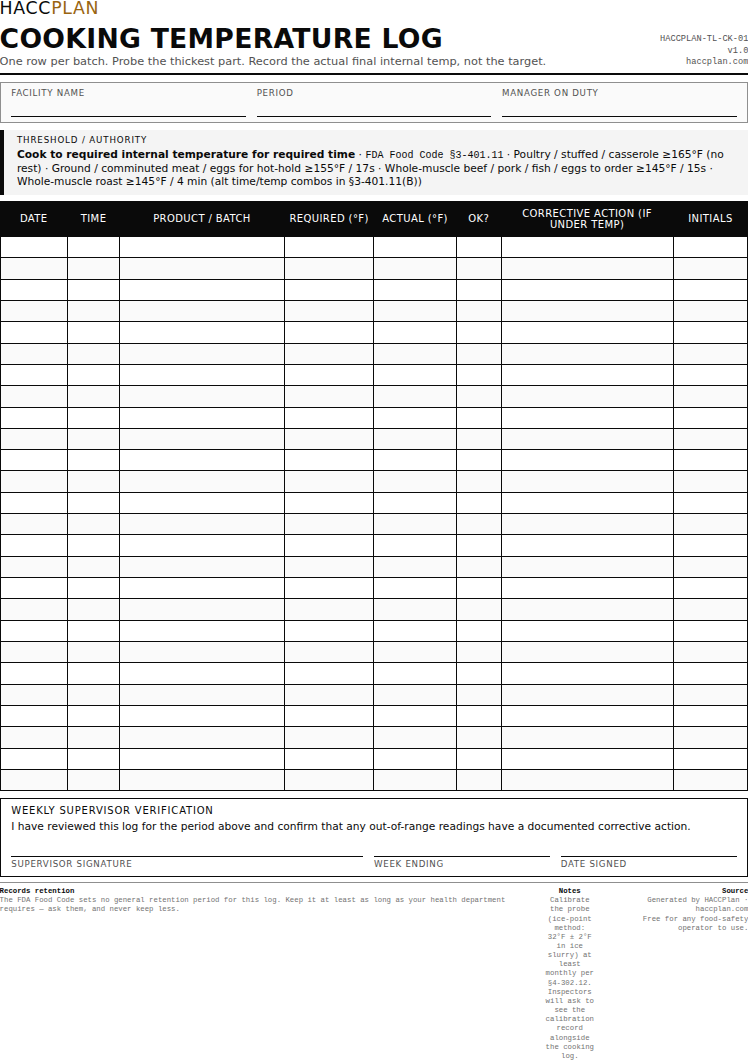
One line per batch. The temperatures are below — poultry, ground meat, whole cuts, roasts — and so is the single habit that turns a good log into a worthless one.
Free. No email, no account. Print it or fill it in on a tablet.
01The numbers
What has to reach what.
| Food | Cook to | Hold it | Rule |
|---|---|---|---|
| Poultry · stuffed meat, fish or pasta · any stuffing with meat in it | 165°F | no rest needed | §3-401.11(A)(2) |
| Ground or minced meat · non-intact meat · eggs you cook and then hold | 155°F | for 17 seconds | §3-401.11(A)(1) |
| Whole cuts of beef, pork or fish · eggs cooked to order | 145°F | for 15 seconds | §3-401.11(A)(3) |
| Whole roasts | 145°F | for 4 minutes | §3-401.11(B) |
| Tinned or packaged ready-to-eat food, heated for the first time | 135°F | — | §3-403.11 |
The Food Code offers other time-and-temperature combinations for ground meat — 145°F for 3 minutes, 150°F for 1 minute. They are all valid. One number is easier to train and easier to check, so this log uses 155°F for 17 seconds.
02Doing it right
Thickest part. Actual number.
Two habits separate a log that means something from one that does not.
Probe the thickest part. Away from bone, away from the pan. The thin edge of a chicken breast is at temperature long before the middle is, and the middle is the bit that matters.
Write what you measured, not what you were aiming for. This is the big one.
A column of identical readings is the clearest sign of a log nobody really filled in.
What inspectors look for first
Real cooking produces 168, 171, 166, 169. A page of 165 down the margin tells an experienced inspector the sheet was completed from memory at the end of service — and once they think that about one log, they think it about all of them.
03The probe itself
An uncalibrated thermometer makes every line worthless.
- 1
Fill a cup with crushed ice, then top it with water
Slush, not cubes with gaps. The ice has to be touching everywhere.
- 2
Stir, then put the probe in the middle without touching the sides
Wait for the number to settle.
- 3
It should read 32°F, within about 2 degrees
If it does not, adjust it if it adjusts, and replace it if it does not.
- 4
Write it down, at least once a month
Keep that record with the cooking log. Inspectors ask for both together, because one is meaningless without the other.
04Getting it wrong
What an inspector notices.
Every reading is exactly the target
Cooking does not produce identical numbers. This is the most common tell there is.
No calibration record
An uncalibrated probe means every temperature on the sheet is unverified. The cooking log and the calibration record are read as a pair.
Poultry logged at 155°F
Chicken is 165°F with no rest. A 155°F entry for poultry is a straightforward miss and easy to spot.
A low reading with no re-cook noted
Undercooked food came off the heat and the sheet does not say what happened next.
05Questions
The things people ask.
Where do I put the probe?
The thickest part, away from bone and away from the pan. Thin edges get hot first, so a probe in the edge tells you the bit that was never at risk is fine.
Do I write the target or what I actually measured?
What you measured. A page reading 165, 165, 165, 165 all the way down is the clearest sign there is of a log filled in at the end of the night. Real readings vary — 168, 171, 166 — and that variation is what makes the sheet believable.
Does the microwave count as cooking?
Yes, with extra steps. Cover it, stir or rotate it partway through, get every part to 165°F, then let it stand covered for 2 minutes before you check. The standing time is part of the cook, not an optional extra.
How often do I calibrate the probe?
At least monthly, using the ice-point method — a proper ice slurry should read 32°F, give or take 2°F. Keep that record too. Inspectors ask for it alongside the cooking log, because an uncalibrated probe makes every number on the sheet meaningless.
The food came up short. What do I do?
Keep cooking and check again. If it went out to a customer below temperature without them asking for it that way, it gets pulled and replaced. A roast that misses 145°F for 4 minutes goes back in until it makes it. Write down every re-cook.
Print it, keep it by the pass, and write the reading as you take it.
Want every threshold on one page for the wall? The cheat sheet has cooking, cooling, holding and reheating together.