Free printable reference
Every temperature your kitchen uses, on one page
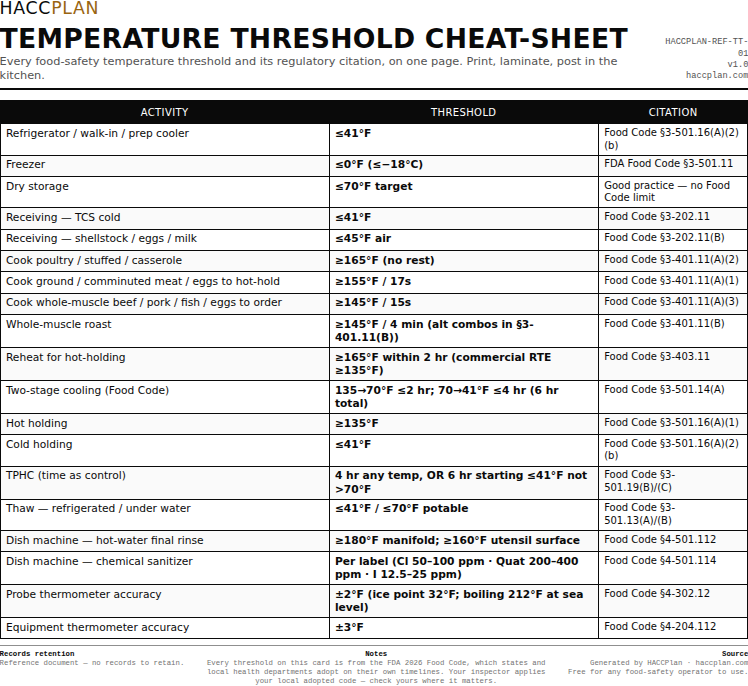
Cooking, cooling, holding, reheating, thawing, warewashing. Each one with the rule it comes from printed right beside it — so when somebody questions a number, the answer is already on the wall.
Free. No email, no account. Print it or fill it in on a tablet.
01What this one is
A reference, not a record.
Every other sheet here gets filled in. This one does not. Nothing to initial, no columns, no dates.
It exists because nobody remembers 155°F for 17 seconds at half past seven on a Friday. Not new cooks, not experienced ones. A single page on the wall beats ten numbers in ten heads, and it settles arguments instantly.
02Why the citations matter
Every row names its rule.
Most temperature posters give you a number and nothing else. This one prints the Food Code section beside each row, and that changes what the page can do.
A number on its own is an opinion once somebody disagrees with it. A number with §3-401.11(A)(2) next to it is checkable — by you, by a new manager, by an inspector standing in your kitchen.
These are the current model Food Code figures. Your state or county adopts its own version, on its own timeline.
Check your local adopted code
The Food Code is a model. It becomes law when a jurisdiction adopts it, and not all of them are on the same edition. Where a number really matters, check the one your health department actually enforces.
03The row nobody knows
You can use time instead of temperature.
Buried in the chart is a line most operators have never been told about, and it solves more real problems than anything else on the page.
Food can be held using time rather than temperature: up to 4 hours at any temperature, or up to 6 hours if it started at 41°F or below and never went above 70°F. At the end of the window it is thrown out — that is the trade [Food Code §3-501.19].
It is not a loophole and it is not an accident. It is a proper control, and for things like a pan of cut tomatoes on a busy line it is often more honest and more workable than pretending a prep top is holding at 41°F through a rush.
It does have conditions: it must be written into your procedures, and the food has to be marked with its discard time. Read the section before you rely on it.
04Where to put it
Where the decisions happen.
By the pass, where cooking temperatures get argued about. In the walk-in doorway, where storage decisions get made. Inside the front cover of the manager’s binder, where an inspector will see it first.
Three copies of a free page is not extravagant. It is the cheapest training aid in the building.
05Getting it wrong
What to watch for.
A chart on the wall that nobody has read
It is decoration if the team cannot find the row they need. Walk a new cook through it once on their first shift.
A faded, splashed copy from three years ago
Codes get updated. A sheet nobody has replaced suggests nobody has checked the numbers either.
Using it instead of your actual logs
The chart says what the target is. Your logs are what show you hit it. An inspector wants both.
06Questions
The things people ask.
Is this the ServSafe chart?
No. We are not affiliated with ServSafe or any certification body. This is an independent chart built from the FDA Food Code, and unlike most wall posters it prints the section number beside every single row so you can check any of them yourself.
Why does every row have a code number next to it?
So the number can be defended. When someone questions a temperature — a new cook, a supplier, an inspector — the answer is on the wall rather than in an argument. It also means you can look the rule up and read the exact wording, including the exceptions.
Do these apply everywhere in the US?
Not automatically. The Food Code is a model code. States and local health departments adopt a version of it on their own timelines, so your local adopted code is what you are actually held to. The numbers here are the current model; check yours where it matters.
What is 'time as a control'?
It is a legitimate alternative to keeping food hot or cold, and most operators have never heard of it. You can hold food for up to 4 hours at any temperature, or up to 6 hours if it starts at 41°F or below and never goes above 70°F — then it is discarded [§3-501.19]. It has to be written into your procedures and the food has to be marked, but it solves real problems on a busy line.
Where should I put it?
Where decisions get made: by the pass, in the walk-in doorway, inside the front of the manager's binder. It is a reference, not a record — nothing on it gets filled in.