Free printable log
The walk-in log, with the door check that saves the stock
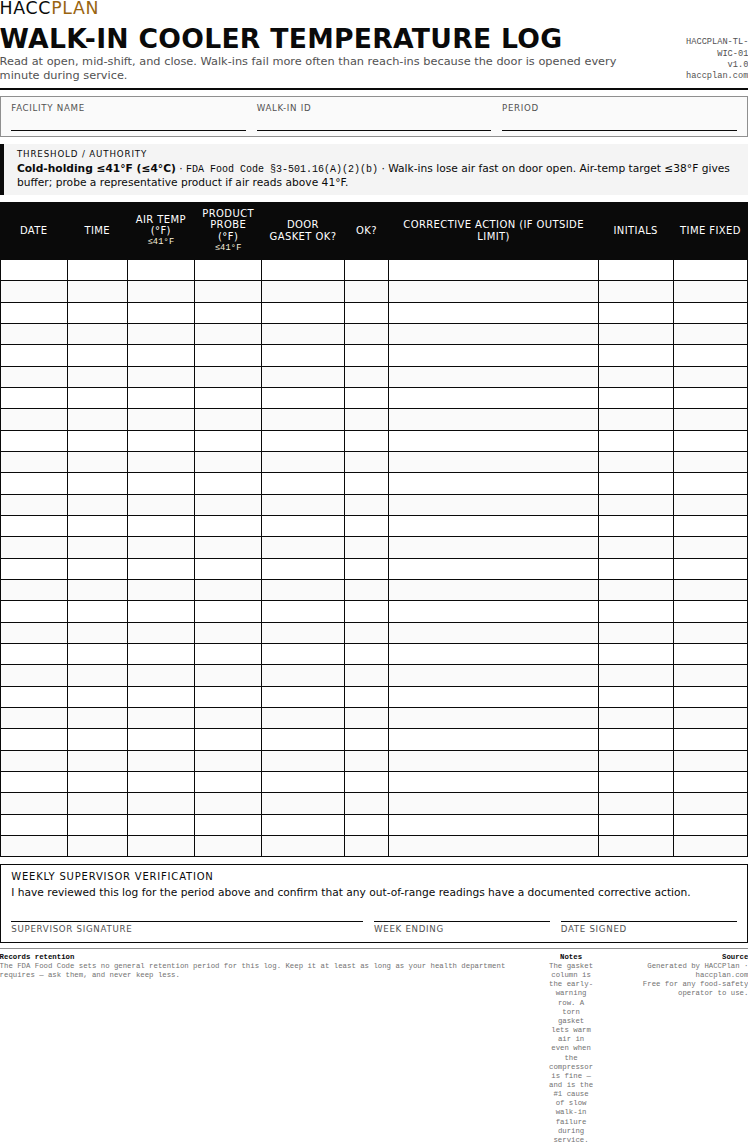
Same temperature rule as any other cooler. Completely different failure. In a walk-in it is almost never the compressor — it is the door, and that is why this sheet has a column most fridge logs do not.
Free. No email, no account. Print it or fill it in on a tablet.
01The rule
41°F, the same as everything else.
Cold food at 41°F (5°C) or below.
FDA Food Code §3-501.16(A)(2)(b)
Nothing special about a walk-in as far as the temperature goes. The difference is everything else.
02What's actually different
It's a room, and the door is the weak point.
A reach-in is a box that opens for three seconds. A walk-in is a room that people stand in, prop open during a delivery, and fill with warm boxes straight off a truck.
So it fails differently. A compressor going is loud and obvious. A gasket splitting is silent — the unit runs perfectly, works harder and harder, and the temperature creeps up over a fortnight while everything looks completely normal.
That is the column on this sheet that other fridge logs do not have. Look at the seal when you take the reading. Run a hand around the edge with the door shut. Thirty seconds, and it catches the expensive failure before it becomes one.
03Where things go
Height, and order.
- 1
Everything at least 6 inches off the floor
This one is about walk-ins more than anything else, because there is floor space and people use it. Boxes on the floor get mopped around, splashed and stepped past [§3-305.11].
- 2
Ready-to-eat on the top shelf
Salads, cooked food, anything that is not going to be heated again. Nothing should ever be able to drip onto it.
- 3
Raw below, in cooking-temperature order
The logic is simple: if something drips, it should land on food that will be cooked hotter than the food it came from [§3-302.11].
- 4
Poultry on the bottom, always
It has the highest cook temperature, so it goes lowest. This is the one everybody remembers and the one worth getting right.
- 5
Covered and labelled
Common name on the label, lid on the container [§3-302.12].
04Where the thermometer goes
The warm corner, not the cold one.
A walk-in is a room, and rooms stratify. The back bottom corner is the coldest place in it, and a thermometer there will give you a lovely number for months.
Put it near the door, high up. That is the warmest part. If the warm corner is at 41°F, everything else already is.
05Getting it wrong
What an inspector notices.
Boxes on the floor
It is the first thing visible on opening the door, and it is in the Code by number. Six inches.
Raw chicken above ready-to-eat food
The cheapest control in the kitchen, ignored. It reframes everything else the inspector sees afterwards.
The gasket column never filled in
The sheet asks a question every day and nobody has answered it, which suggests the reading above it is being copied too.
A shared sheet with the reach-ins
When a reading is high it cannot show which unit, so it cannot show the right one was fixed.
06Questions
The things people ask.
Is the temperature different for a walk-in?
No. 41°F or below, same as any other cold holding [Food Code §3-501.16]. What is different is how a walk-in fails and how much it costs when it does.
Why is there a gasket column?
Because a torn door seal is the most common reason a walk-in slowly stops holding temperature. The compressor is fine, the unit is running, and warm air is leaking in around the door all day. It is a thirty-second look that catches an expensive problem early.
Where does the thermometer go?
The warm corner — near the door, high up. A walk-in is a room, so it stratifies: the back bottom corner is always the coldest place in it. A thermometer there reads beautifully and tells you nothing useful.
How high off the floor does food need to be?
At least 6 inches [§3-305.11]. This matters far more in a walk-in than a reach-in, simply because there is floor space to stack on and people use it.
What order should things be stacked in?
Ready-to-eat on top. Below that, raw foods in order of their cooking temperature, with poultry on the bottom shelf [§3-302.11]. The logic is drips: anything that falls should land on something that is going to be cooked hotter than the thing it fell from.
Can it share a sheet with my reach-ins?
No. One sheet per unit. When a reading is high you need to be able to show which box was warm and which one you fixed.
Print it, hang it on the outside of the door, and look at the seal while you write.
Reach-ins and prep coolers use the fridge log — same rule, one sheet per unit.