Free printable log
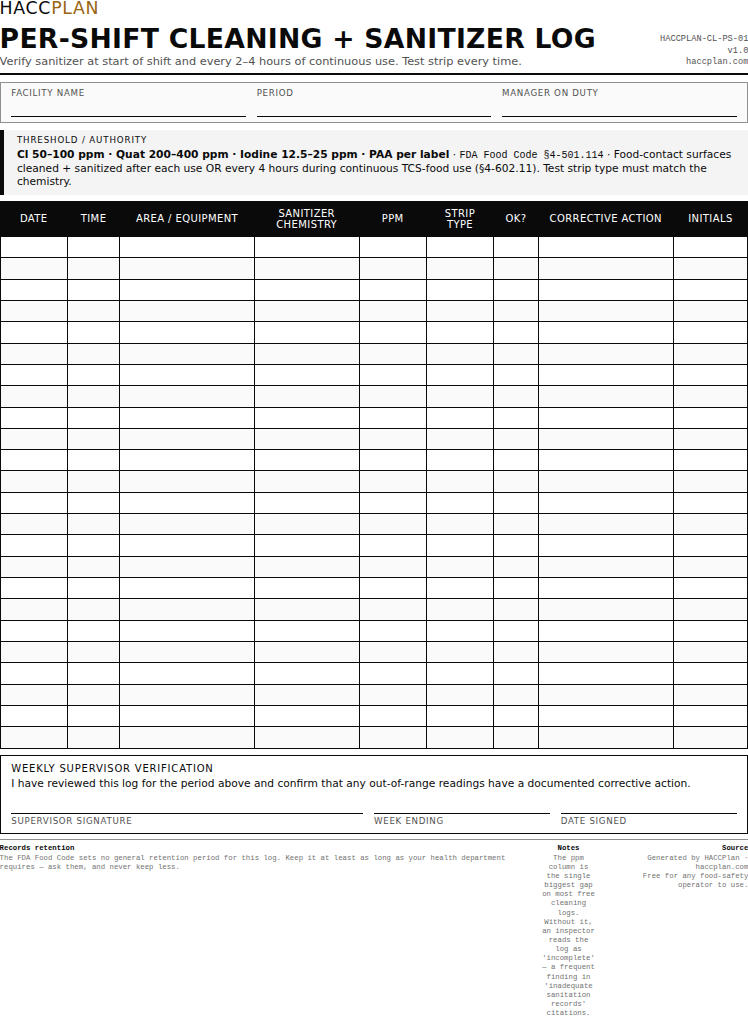
The sanitizer log — the column that closes the gap
A cleaning checklist shows the job was done. This sheet shows it was done properly. It is the one most kitchens are missing, and the one behind most 'inadequate sanitation records' findings.
Free. No email, no account. Print it or fill it in on a tablet.
01The numbers
Strength, and the temperature nobody mentions.
Chlorine 50–100 ppm · Iodine 12.5–25 ppm · Quat at the label, usually 200 ppm
FDA Food Code §4-501.114
Quat is the one where you follow the bottle rather than a fixed number — different products are mixed differently.
And here is the part that catches people: the water temperature is part of the rule, not a nicety. A chlorine solution between 50 and 99 ppm needs water at 100°F or warmer. If you actually test the solution’s pH and it comes in at 8 or below, 75°F does it. A full-strength 100 ppm solution only needs 55°F.
A perfectly-mixed bucket in cold water is not a compliant sanitizer. That is why the sheet has a temperature column next to the ppm column.
02The honest bit
A bucket mixed by eye is usually too weak.
Nobody means to get this wrong. A cap-full looks about right, the water goes cloudy, the bucket looks like every other bucket anyone has ever made.
It is usually under strength. Which means the cloths went in, came out, wiped the boards — and nothing was sanitized. The surfaces look clean and the job is not done.
Going the other way is its own problem: a bucket mixed too strong leaves chemical on a food-contact surface. There is no version of this you can eyeball. That is the whole reason the strip exists and the whole reason for this sheet.
03Getting a real reading
How to test it properly.
- 1
Check the strips before you check the bucket
In date, dry, capped. Strips kept in a damp drawer read low and will quietly make every entry on this sheet wrong.
- 2
Dip once, don't swirl
Follow the tub’s instructions. Most want a quick dip, not a stir.
- 3
Read it against the chart in good light
Not under a heat lamp, not in the walk-in doorway.
- 4
Take the water temperature at the same time
Same bucket, same moment. Both numbers go on the same line.
- 5
Out of range? Dump, remix, re-test before use
And re-wash anything that went through the bad bucket. Record the failed reading as well as the remake — a corrected problem is a good record, not an embarrassing one.
04Getting it wrong
What an inspector notices.
The same ppm on every single line
Buckets get used, diluted and topped up. Identical readings all shift read as a sheet filled in once.
The temperature column left blank
Strength without temperature is half a specification. It is the most commonly empty column on this kind of sheet.
Test strips past their date
Every reading taken with them is unverified, which makes the whole sheet unverified too.
A failed reading with no re-test after the remake
The sheet shows you found a problem and never shows that you fixed it.
05Questions
The things people ask.
What strength should my sanitizer be?
Chlorine 50 to 100 ppm. Iodine 12.5 to 25 ppm. Quat at whatever the label on your product says, which is usually around 200 ppm [Food Code §4-501.114]. Quat is the one where the label wins — different products are formulated differently.
Does the water temperature matter?
Yes, and it is the part people miss. A chlorine solution at 50 to 99 ppm needs water at 100°F or warmer to work. If you test the solution and its pH is 8 or below, 75°F is enough. A 100 ppm solution only needs 55°F. Correct ppm in cold water is still not a compliant sanitizer.
How long does it need to touch the surface?
Chlorine at least 10 seconds. Quat at least 30 seconds, or longer if the label says so [§4-703.11]. Then let it air dry — wiping it off takes the sanitizer with it.
Can I just judge the strength by eye?
No, and this is the single most common mistake. A bucket mixed by eye is usually too weak, which means everything sanitized in it was not really sanitized. Too strong is its own problem — that is a chemical hazard on a food-contact surface.
The strip says it is out of range.
Dump the bucket, mix a new one, and test it before anything touches it. Then re-wash and re-sanitize whatever went through the bad solution. Write both the failed reading and the remake on the sheet.
Why do my strips read low all the time?
Check where they live. Test strips kept in a damp drawer degrade and read low, and a low strip quietly makes every entry on your sheet wrong. Keep them dry, capped, and check the expiry date.
Print it with the daily checklist and keep both on the same clipboard.
This is the partner sheet to the daily cleaning checklist. One shows the job happened; this one shows it worked.