Free printable checklist
The kitchen cleaning list that turns into a record when you sign it
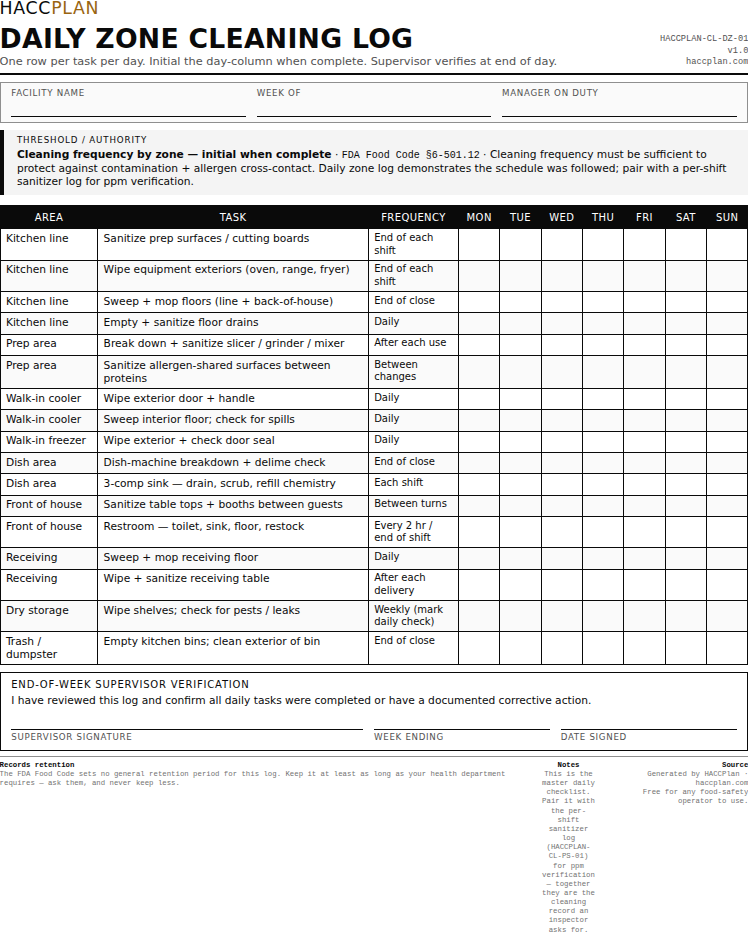
Seventeen jobs across eight areas, one line each, a box for every day of the week. Unsigned it is a plan. Signed it is proof. Here is how to use it, and the one rule most cleaning checklists leave out entirely.
Free. No email, no account. Print it or fill it in on a tablet.
01What this sheet really is
A plan and a record, on one page.
Most cleaning checklists are a list of jobs. This one is a list of jobs with a box beside each of them for every day of the week.
That small difference is the whole point. Before anyone writes in it, it is a schedule — it says what your kitchen has decided to do. After someone initials a box, that same square is evidence the job got done, by a person, on a date.
An inspector asking about cleaning is asking for the second thing. Most kitchens only have the first.
02The rule nobody prints
Four hours, not end of shift.
Here is the one that catches people out. If a surface touches food that needs to stay cold or hot, and that surface is sitting out at room temperature, it has to be cleaned and sanitized every four hours.
Food-contact surfaces: clean and sanitize at least every 4 hours.
FDA Food Code §4-602.11
There is a longer allowance for surfaces kept under refrigeration, and the Code has a table for it. But the cutting board on your line, at room temperature, during a long service — four hours.
Nearly every free cleaning checklist says “end of shift” for prep surfaces. On a ten-hour day, that is not the same thing, and it is the gap an inspector finds.
03Doing it properly
Wash, rinse, sanitize, air dry.
The order matters and the last step is the one people skip.
- 1
Wash
Soap and hot water. This lifts the grease and the bits. Sanitizer cannot work through soil, so nothing after this step counts if you skip it.
- 2
Rinse
Clean water. Leftover soap stops the sanitizer from doing its job.
- 3
Sanitize — at the right strength, for long enough
Chlorine at 50 to 100 ppm, touching the surface for at least 10 seconds. Quat at whatever the label says, usually 200 ppm, for at least 30 seconds. Iodine 12.5 to 25 ppm. Check with a test strip, not by eye — a bucket mixed by eye is usually too weak [Food Code §4-501.114, §4-703.11].
- 4
Air dry
Leave it. Wiping a sanitized surface with a cloth takes the sanitizer straight back off, and puts whatever was on the cloth back on.
04When it goes wrong
A weak bucket means doing it again.
If a test strip says the sanitizer is out of range, the fix is not to add a splash more. Dump it, mix it again, and test it before anything else touches it.
Then deal with what was already done in it. Anything sanitized in an out-of-range bucket has to be washed and sanitized again. That is annoying, and it is exactly why testing at the start of the shift is cheaper than testing at the end.
If a job on the list did not get done, do it and note it. Do not go back and initial an empty box the next morning — a record that says something happened when it did not is worse than a blank.
05The manager's job
Checking it means picking up a test strip.
Signing at the bottom of the day is not the same as checking it. A real check has three parts.
Read the sheet for blanks and for a week that looks too perfect. Test a sanitizer bucket yourself, right then. And look at the test strips — are they in date, and are they being kept somewhere dry? Strips left in a damp drawer read low, and a low strip quietly makes every entry on the sheet wrong.
06Getting it wrong
What an inspector notices.
Every box ticked, every day, no exceptions
Real kitchens have a day the fryer was down and nobody worked that zone. A flawless grid reads as filled in on Friday afternoon.
One person's handwriting for a week with four closers
It shows one person signed for work they did not watch. The signature is supposed to mean something.
No sanitizer strength written down anywhere
This is the 'inadequate sanitation records' finding. The task sheet shows the job was done; the ppm log shows it was done properly. Bring both.
Tasks for equipment you do not own
A line about the slicer in a kitchen with no slicer proves the list was downloaded and never read.
07Questions
The things people ask.
How often does the Food Code say I have to clean?
For most of the kitchen it does not give a number. §6-501.12 says the place has to be cleaned as often as it needs to be. That sounds vague, and it is — on purpose. You decide the frequency, you write it on a schedule, and then you are held to your own schedule. That is what this sheet is.
What is the four-hour rule?
If a food-contact surface is touching food that needs temperature control, and it is sitting at room temperature, it has to be cleaned and sanitized at least every four hours [Food Code §4-602.11]. Not at the end of the shift. Every four hours. There is a longer allowance for surfaces kept under refrigeration, and the section has a table for it.
Do I have to write down the sanitizer strength?
On this sheet, no — this one is the task schedule. The strength readings go on the per-shift sanitizer log, which is its own sheet. The two are designed as a pair, and a health department that asks about cleaning records usually wants both.
Can I just change the task list?
You should. A list with tasks for equipment you do not own tells an inspector you downloaded something and never read it. Cross out what does not apply, write in what does, and keep the areas that match your actual kitchen.
Who signs it?
Whoever did the job initials the box. A manager checks and signs at the end of the day. Those are two different people doing two different jobs, and it matters — the second signature is what makes it a checked record instead of a to-do list.
How long do I keep the sheets?
The Food Code does not set a general retention period. Your health department does. Ask them, and never keep less than they ask for.
Print it on Monday, put it where the closers can reach it, and cross out any line that does not match your kitchen before the week starts.
Pair it with the per-shift sanitizer log for the strength readings — together they are the cleaning record a health department asks for.