Free printable log
Calibration: the log that decides whether your other logs mean anything
A probe reading four degrees low does not just give you one wrong number. It quietly makes every cooking and holding reading it took since the last check unverified. That is what this sheet is really for.
Free. No email, no account. Print it or fill it in on a tablet.
01The rule
Two degrees, either way.
Food thermometers must be accurate to ±2°F (±1°C) in the range they are used.
FDA Food Code §4-502.11(B)
The Code gives the accuracy and stops there. It does not tell you how often to check — that is your schedule to set, and then to keep.
Monthly is what most kitchens settle on, and what this sheet is laid out for.
02Doing it right
The ice-point check, properly.
Most people do a version of this. The details are what make it a real check rather than a ritual.
- 1
Crushed ice first, then top up with water
A slurry, not a cup of cubes with air between them. Air pockets are the usual reason a check comes out wrong.
- 2
Stir it, and let it sit for a moment
You want the whole thing at one temperature before you measure it.
- 3
Probe in the middle, not touching the sides or bottom
The cup is at room temperature. Touch it and you are measuring the cup.
- 4
Wait for the number to stop moving
Then read it. It should be 32°F, give or take two.
- 5
Write the actual reading, not 'OK'
31.4 is a reading. 'OK' is an opinion. And if it drifts a little each month, the numbers are what let you see it coming.
Boiling water works too, but it is altitude-dependent — 212°F at sea level and lower the higher you are. Ice is 32°F everywhere, which is why it is the one to use.
03The part people miss
A failed probe reaches backwards.
Say the probe is 5°F low. You replace it and move on. That is half the job, and it is the wrong half to stop at.
Every reading that probe took since its last good check was 5°F low too. The chicken you logged at 165°F was at 160°F. The cooler you logged at 40°F was at 45°F. A month of records just became unverified.
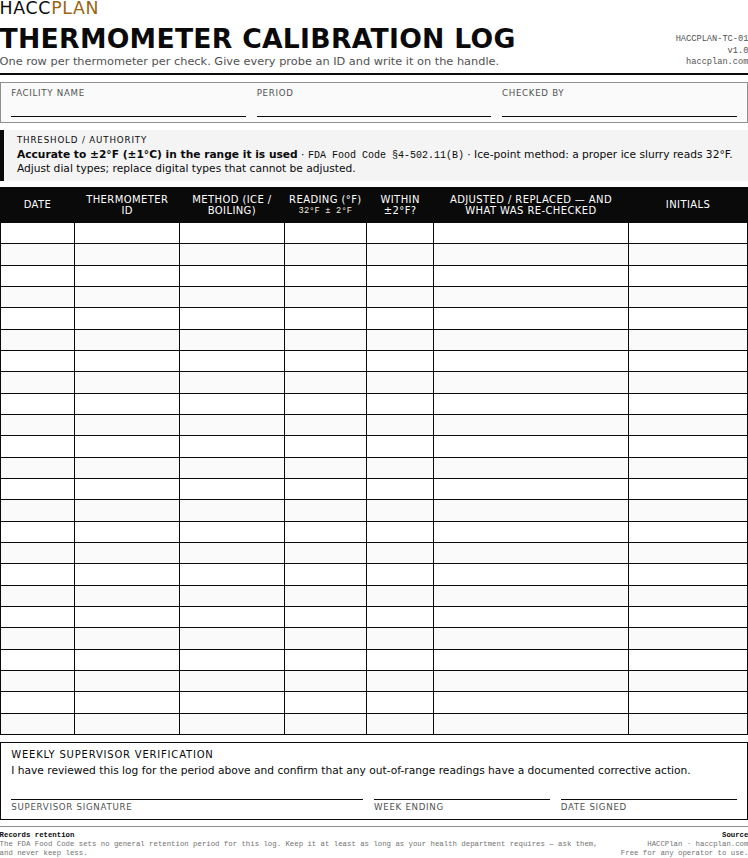
So the action column asks two things: what you did about the probe, and what you re-checked because of it. Look at food still on hand. If a critical limit might have been missed, record it as a deviation — that is not an admission of failure, it is the system working.
04Small thing, big difference
Give every probe a name.
Write an ID on each handle in permanent marker. Probe 1, Probe 2, Line, Prep, whatever makes sense.
Without it the log cannot say which thermometer failed — which means it cannot tell you which readings to go back and question. An ID turns a monthly chore into something that actually protects you.
05Getting it wrong
What an inspector notices.
No thermometer IDs
The log cannot show which probe failed, so a failure cannot be traced to the readings it affected.
A failed check with nothing re-checked
The sheet shows you found an unreliable probe and never asked what it had already measured.
Dates that stop a few months back
A schedule that quietly ended. You are measured against the frequency you set yourself.
'Adjusted' next to a probe that has no adjustment
Most digital probes cannot be calibrated, only replaced. It suggests the entry was written without the probe in hand.
06Questions
The things people ask.
How accurate does a probe have to be?
Within 2°F either way, in the range you actually use it [Food Code §4-502.11(B)]. For Celsius devices it is 1°C.
How often should I check them?
The Code does not say. Monthly is what most kitchens do and what this sheet is laid out for. Whatever you choose, write it in your plan — you will be measured against your own schedule, not against a rule that does not exist.
Ice water or boiling water?
Ice, almost always. Boiling point changes with altitude — 212°F at sea level and lower as you climb — so you need to know your elevation and correct for it. An ice slurry is 32°F everywhere, which makes it the reliable check.
My digital probe is 4°F out and won't adjust.
Then it gets replaced. Many digital probes have no adjustment at all, and 'adjusted' written next to one that cannot be is an entry an inspector will notice.
Does a failed check matter for food I already served?
This is the part people miss, and it is the whole reason the log has an action column. Every reading that probe took since its last good check is now unverified. Re-check anything still on hand, and if a critical limit might have been missed, record it as a deviation.
Why does each thermometer need an ID?
So the log can say which one failed. A sheet full of readings with no IDs cannot tell you which probe to distrust, which makes the retrospective check impossible. Write the ID on the handle in marker.
Print it, keep it with the cooking log, and put a monthly reminder in the calendar.
This sheet and the cooking log get read as a pair — one records the temperatures, the other shows the thermometer could be trusted.