Free printable log
The pest log, where the empty weeks are the point
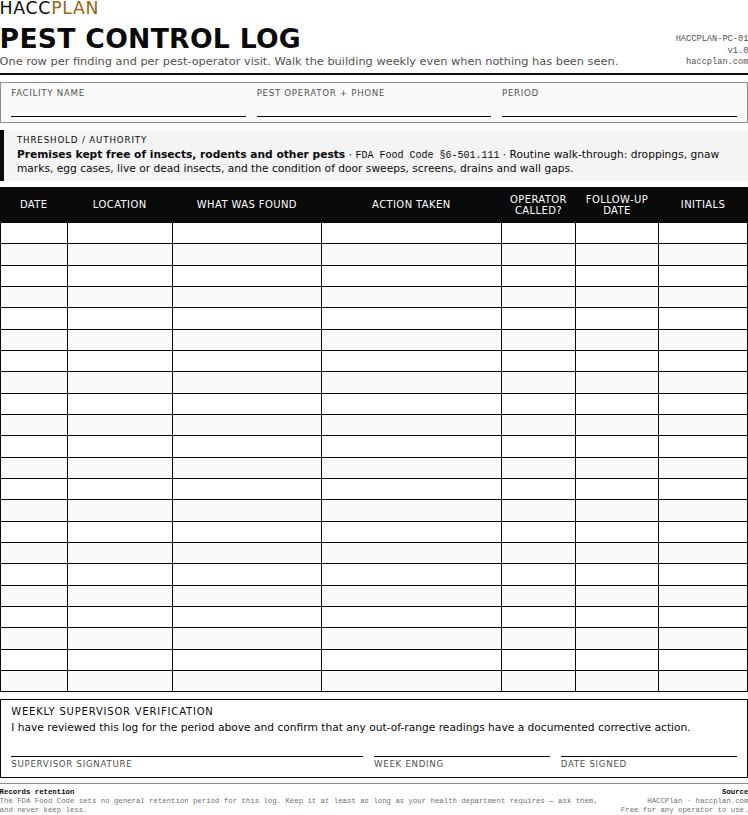
Most pest logs only get written in when something turns up. That is exactly backwards — a sheet with three entries in a year shows three findings and eleven months of nobody looking. Here is how to use it properly.
Free. No email, no account. Print it or fill it in on a tablet.
01The rule
Free of pests. Not 'mostly'.
The premises shall be maintained free of insects, rodents and other pests.
FDA Food Code §6-501.111
Free of. Not controlled, not managed, not within reason. That is a high bar written plainly, and it is why the walk-through matters more than the contract.
Two more sit alongside it: dead or trapped pests get removed from traps and from the building [§6-501.112], and the outside openings have to be protected — door sweeps, screens, sealed gaps [§6-202.15].
02The thing most people get wrong
Write it down on the weeks you find nothing.
Here is the entry that does the real work: “Weekly walk-through. Nothing found.” Dated, initialled, boring.
A log that only contains findings looks, to somebody reading it later, like a log that only exists when there is a problem. Three entries in a year is three problems and eleven months of silence — and silence does not prove anybody was checking.
Fifty-two dull entries and two real ones is a completely different document. It shows a system that was running, caught something, and dealt with it.
03What to look for
Evidence, not animals.
If you are waiting to see a mouse, you will be waiting a long time and the population will not be waiting with you.
- 1
Droppings, along walls and behind equipment
Rodents travel the edges of a room. Pull the bins out and look where nobody looks.
- 2
Gnaw marks on packaging, trim and pipe lagging
Chewed cardboard in dry storage is usually the first sign anyone actually notices.
- 3
Egg cases and dead insects
Especially in warm cavities — behind the dish machine, under the line, around motors.
- 4
The ways in
Door sweeps that no longer touch the floor. Torn screens. Gaps around pipework. This is the half of the job that stops it happening again.
- 5
The bin area outside
What is happening at the dumpster arrives in the kitchen eventually.
04When you find something
Food, surface, entry point, phone.
In that order, and all four get written on the line.
Throw out any food they could have touched. Clean and sanitize the area properly. Find the way in and seal it. Call your pest operator for anything beyond a single fly.
Then set a follow-up date, because the column is there for a reason. Killing what is inside without closing the gap is a bill you pay again next month.
05A word about contracts
A service is not a programme.
Having a pest company is good. It is not the same as meeting the rule, and it is worth being clear-eyed about why.
They visit monthly. You are open every day. The Code asks about the state of your building, not the state of your contract — so the weekly walk-through is what covers the twenty-nine days they are not there.
Keep their service reports with this log. Together the two are a complete record. Either one on its own is half an answer.
06Getting it wrong
What an inspector notices.
Entries only when something was found
It reads as a log that exists when there is a problem, rather than a routine that catches them.
A finding with no action written beside it
You have recorded evidence of pests and no evidence of doing anything about it.
No follow-up date after a live finding
Suggests the problem was cleaned up rather than solved.
Nothing about door sweeps or screens
The Code names the openings specifically. A log that never mentions them is only watching half the problem.
07Questions
The things people ask.
How often should I walk the building?
Weekly, and write it down even when you find nothing. The Code does not name a frequency — it says the premises have to be free of pests [§6-501.111] — so the schedule is yours, and the log is what shows you kept it.
Isn't having a pest control contract enough?
No. A contract is a service; the rule is about the state of your building. Your operator visits monthly and you are open every day. The weekly walk-through is what covers the gap, and it is what an inspector is looking for alongside the operator's reports.
What am I actually looking for?
Evidence, not animals. Droppings, gnaw marks on packaging or trim, egg cases, live or dead insects. Also the ways in: door sweeps that no longer touch the floor, torn screens, gaps around pipework, the state of the bin area outside.
I found droppings. What do I do?
Throw out any food they could have touched. Clean and sanitize the area. Find and seal the way in. Call your pest operator for anything more than a single fly. Then write all of it down, including a follow-up date.
Where do the operator's reports go?
With this log, in the same place. Your walk-throughs and their service reports are two halves of one record, and an inspector will want both together rather than hunting for the second one.
How long do I keep it?
The Food Code sets no general retention period. Your health department does — ask them, and never keep less than they ask for.
Print it, put it in the binder with your operator’s reports, and book a repeating weekly reminder.
The bin area and the drains are on the daily cleaning checklist too — the two sheets are looking at the same problem from different ends.