Free printable log
The freezer log, and the number the rulebook never gives you
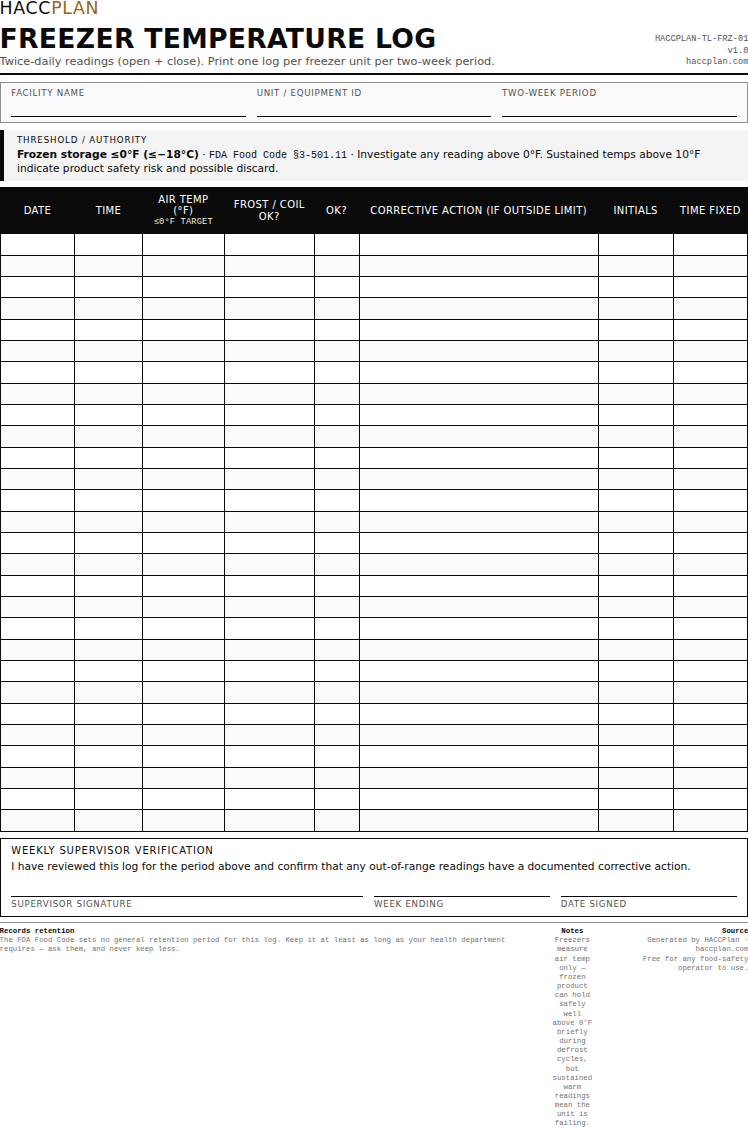
Two readings a day, one sheet per freezer. Simple to fill in — but worth two minutes of your time to understand, because the target printed on it is not actually a legal limit, and knowing why changes how you read it.
Free. No email, no account. Print it or fill it in on a tablet.
01Start here
The Food Code does not name a freezer temperature.
This surprises people. Look up the rule for frozen storage and you find one short sentence.
Stored frozen foods shall be maintained frozen.
FDA Food Code §3-501.11
That is it. No degrees. No target. Just “frozen”.
So where does 0°F come from? It is the number the industry settled on, because food held at 0°F stays properly hard-frozen even when the door opens forty times a service and the unit runs a defrost cycle overnight.
It is a good target. It is just worth knowing that you are choosing it rather than meeting it — and that an inspector is looking at whether the food is frozen, not whether your gauge said zero.
02What it is really for
Catching a failure, not proving a number.
A cooler that drifts is a safety problem within hours. A freezer that drifts is something slower and more expensive.
Nothing becomes dangerous on Saturday. By Monday you have a walk-in of softened stock, no way to say how long it was like that, and a decision to make about several thousand dollars of food.
Two readings a day is what turns that into a Saturday morning phone call to a repair company instead.
03When something is soft
What to do, in order.
The first rule of a thawed freezer: do not put it back.
- 1
Probe it before you decide anything
Soft is not a temperature. Put a clean probe into the thickest part and read an actual number.
- 2
41°F or below? Move it to a cooler and date it
Write “thawed on” with today’s date, put it in a working cooler, and use it inside your normal date-marking window. It is still good food.
- 3
Never refreeze it
This is the one people get wrong. Refreezing destroys the texture and, worse, hides the history — the next person to find it has no idea it was ever thawed.
- 4
Above 41°F and you don't know for how long? Throw it out
You cannot show it is safe, so it is not safe. Write down what you discarded.
- 5
Fix the unit, and write down what happened
Door seal, iced-up coil, failing compressor. Log the reading, the action and who you called.
04Getting it wrong
What an inspector notices.
Fourteen days at exactly 0°F
No real freezer holds one number for a fortnight. Identical readings read as a sheet filled in from memory.
A defrost spike with no note
The spike is normal. Saying nothing about it suggests nobody understood the number they were writing down.
Soft food found, action column blank
You have written proof you saw it and none that you did anything.
One sheet for two units
When a reading is bad, the sheet cannot say which freezer caused it.
05Questions
The things people ask.
What temperature does a freezer legally have to be?
There isn't one. The Food Code says stored frozen food has to be kept frozen [§3-501.11] and stops there. It never names a number. 0°F is what the industry uses because it keeps food hard-frozen with room to spare, but it is a target you are choosing, not a law you are meeting.
Then why keep a log at all?
Because a freezer fails quietly and expensively. A unit drifting up over a long weekend does not make anyone sick on Monday — it ruins a walk-in full of stock and leaves you unable to prove what happened. Two readings a day catches it on the first shift.
Something thawed. Can I refreeze it?
No. If it is still at 41°F or below, move it to a cooler, write 'thawed on' with the date, and use it inside your normal date-marking window. Refreezing it is the one thing not to do. If it is above 41°F and you cannot say for how long, throw it out.
The reading jumped during defrost. Is that a fail?
No, and noting it is the mark of someone who knows what they are looking at. Self-defrosting units spike on a cycle. Write the reading and write 'defrost cycle' beside it. A log that sails through a spike with no comment looks like nobody was really reading the gauge.
One sheet for two freezers?
One sheet per unit, with the unit name at the top. If a reading is bad, a shared sheet cannot show which freezer went wrong.
Print one per freezer, name the unit at the top, and hang it on the door.
Running coolers too? The fridge log works the same way, with one important difference — for a cooler, the Code really does give you a number.