Free printable log
The illness log, and the decision you make in about ninety seconds
Somebody tells you at the start of a shift that they were sick last night. What you do in the next minute or two matters more than almost anything else you will decide that week. This sheet is where that decision gets recorded.
Free. No email, no account. Print it or fill it in on a tablet.
01What must be reported
Five symptoms and six diagnoses.
Vomiting · diarrhoea · jaundice · sore throat with fever · infected or uncovered wound on hands, wrists or exposed skin
FDA Food Code §2-201.11
Plus a diagnosis of any of the six listed illnesses: Norovirus, Hepatitis A, Shigella, Shiga toxin-producing E. coli, Salmonella Typhi, or non-typhoidal Salmonella.
Staff report to the person in charge. The person in charge then has to act — and the acting is the part this log records.
02The decision
Excluded and restricted are not the same word.
People use them interchangeably. They are two different outcomes.
Excluded means not on the premises. Go home.
Restricted means they can work, but nowhere near food or clean equipment. Front of house, admin, dish pit in some cases.
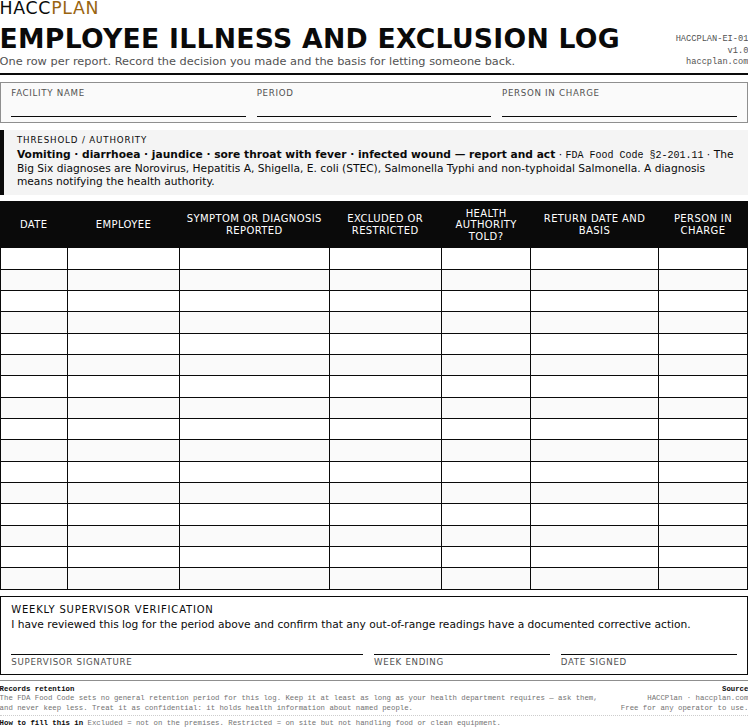
The log has a column for this because you have to choose one, and because an inspector asking about a past illness will want to know which you chose and why.
03When it is happening now
What to do, in order.
- 1
Send them home
Someone actively vomiting, with diarrhoea, or jaundiced does not finish the shift. This is immediate, not end-of-service.
- 2
Bin the ready-to-eat food they handled
This shift, everything they touched that is not going to be cooked again. It is the step most often skipped and the one that protects customers.
- 3
Clean up properly — not with ordinary sanitizer
Vomit spreads norovirus through the air across a wide area. Normal food-contact sanitizer is not a norovirus disinfectant. Use a product rated for it, wear a barrier, and clean a much wider radius than looks necessary.
- 4
Tell the health authority if there is a diagnosis
A confirmed listed illness means a call. Record that you made it.
- 5
Write all of it down on this sheet
The report, the decision, the food, the call. Ninety seconds now, and a complete answer later.
04Coming back
A basis, not a feeling.
The return column asks for a date and a basis, and the second half is the one people leave empty.
Generally that means 24 hours clear of symptoms. Where a listed illness was diagnosed, it means written clearance. “Said they felt fine” is not a basis, and writing the real one down protects you as much as anyone.
05One more thing
Keep this one confidential.
Every other sheet on this site can live in the binder an inspector flicks through. This one holds health information about named people.
Keep it separate and keep it private. It should be producible on request — not sitting open on the pass.
06Getting it wrong
What an inspector notices.
No illness log at all
In any kitchen with staff, over any length of time, somebody has been ill. No log means no system.
A symptom recorded with no decision beside it
It shows someone reported and nothing visibly happened.
A return date with no basis
The date says when they came back. The basis says why that was safe, and it is the half that matters.
No signed reporting agreement anywhere
Staff are supposed to know what to report before they are ill. The agreement is signed on day one, not on a bad morning.
07Questions
The things people ask.
What has to be reported to me?
Vomiting, diarrhoea, jaundice, a sore throat with fever, and an infected or uncovered wound on the hands, wrists or exposed skin. Plus a diagnosis of any of the six listed illnesses [Food Code §2-201.11].
What are the 'Big Six'?
Norovirus, Hepatitis A, Shigella, Shiga toxin-producing E. coli, Salmonella Typhi, and non-typhoidal Salmonella. A diagnosis of any of them means you notify your health authority — that is not optional and not something to sit on.
What is the difference between excluding and restricting?
Excluded means not on the premises. Restricted means they can be at work but cannot handle food or clean equipment. Two different decisions, and the log asks you to record which one you made, because an inspector will ask.
Someone was vomiting during service. What about the food?
Ready-to-eat food they handled that shift gets discarded. This is the step managers skip most often and it is the one that actually protects customers. Send them home first, then deal with the food, then write both down.
When can they come back?
With a basis, not a feeling. Generally 24 hours clear of symptoms, and for a diagnosed illness, written clearance. 'Said they felt better' is not a return basis, and the column asks you to name the one you used.
Is ordinary sanitizer enough after a vomiting incident?
No, and this catches a lot of kitchens out. Vomit aerosolises norovirus across a wide area, and normal food-contact sanitizer is not a norovirus disinfectant. You need a product rated for it, a barrier between you and the mess, and a wide clean-up radius.
Can I keep this in the main binder?
Better not to. It holds health information about named people. Keep it confidential and separate from the folder you hand over casually.
Print it, keep it somewhere private, and make sure whoever holds the keys knows the five symptoms by heart.
A discard after an illness also belongs on the corrective action log.