Free printable log
The dish machine log, and the gauge that isn’t telling you the truth
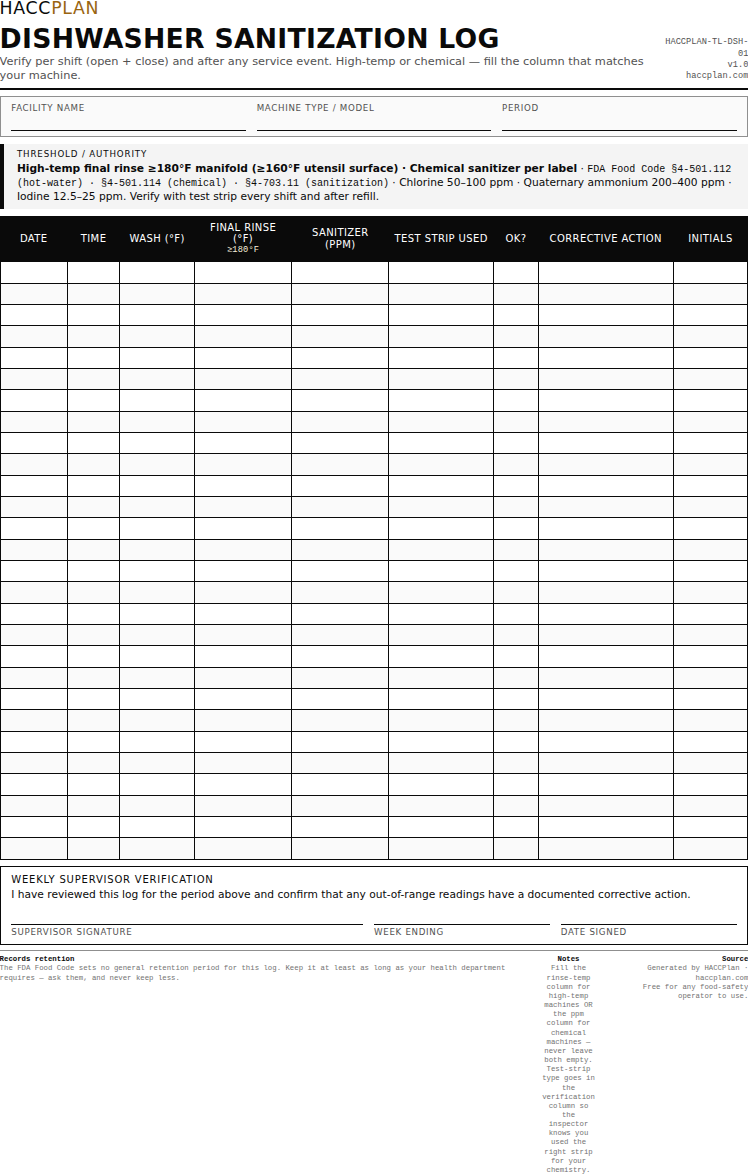
Your machine has a dial on the front. It is not measuring the thing the rules care about. This sheet has two temperature columns for that reason, and understanding the difference is most of what there is to know.
Free. No email, no account. Print it or fill it in on a tablet.
01Start here
The dial measures the machine. Not the plate.
The gauge on the front of a hot-water machine reads the manifold — the water heading into the rinse arms. It is a useful number and it is not the number that matters.
180°F at the manifold. 160°F at the surface of the dish. Never above 194°F.
FDA Food Code §4-501.112
A stationary rack, single-temperature machine runs at 165°F instead. The 160°F utensil-surface figure applies either way.
Water can leave the manifold at 180°F and arrive at the plate considerably cooler — worn arms, blocked jets, a rack packed too tight. The only way to know what the dish got is to measure the dish.
02Measuring properly
You cannot do this with a normal probe.
By the time you open the door and stick a thermometer on a plate, it has cooled. The reading you get is the reading after the event.
Use a heat label — a sticker that changes colour permanently at a set temperature and does not change back — stuck to a plate and run through with a normal load. Or a maximum-registering thermometer, which holds the highest temperature it saw.
Either way the point is the same: something that remembers. Then write both numbers on the sheet, manifold and surface.
03Chemical machines
Same sheet, different column.
If your machine sanitizes with chemical rather than heat, the temperature columns matter less and the ppm column becomes the whole game. Sanitizer at the strength the label states, with the contact time the label states.
Test it with a strip, from the machine, at the rack — not from the bottle. The question is what reached the dish, which is the same question the hot-water machine is asking in a different language.
04When it fails
Stop, fix, re-run.
- 1
Stop using it
Everything going through a machine that is not making temperature is coming out unsanitized, however clean it looks.
- 2
Check the obvious things first
Is it up to temperature yet? Is the chemical container empty? Are the rinse arms blocked? Is it due a delime?
- 3
Re-run the last load
The rack that came out before you noticed goes back through once the machine is right.
- 4
Write down all three parts
The low reading, what you did, and the re-run. A sheet that only records good readings is not a record of anything.
05Getting it wrong
What an inspector notices.
Manifold column filled, utensil column blank
It shows the machine was watched and the dishes were not. The 160°F surface figure is the one being tested.
No heat label or test strip recorded anywhere
Without it the numbers are what somebody believed rather than what was measured.
Readings that never move
A real machine varies with load, incoming water and time of day.
A low reading and no re-run
A rack of unsanitized plates went out to the floor and the sheet says so.
06Questions
The things people ask.
What temperature does the dish machine need to hit?
For most hot-water machines, 180°F at the manifold. A stationary rack, single-temperature machine is 165°F. Never above 194°F. And separately, 160°F at the surface of the dish itself [Food Code §4-501.112].
Why are there two temperature columns?
Because the machine's gauge and the plate are not the same thing. The manifold reading tells you what the machine is doing. The utensil reading tells you what actually reached the dish, and that is the one the Code is about.
How do I measure the utensil surface?
A heat label — an irreversible temperature indicator you stick to a plate and run through — or a maximum-registering thermometer. You cannot get it with a normal probe, because by the time you open the door and probe a plate it has already cooled.
Is hotter better?
No. Above 194°F the water flashes to steam before it can transfer its heat to the dish, so you get a scalding machine and colder plates. The ceiling is there for a reason.
My machine used to pass and now it doesn't.
Delime it. Scale builds on the heating elements and quietly strangles the temperature. It is the most common cause of a machine that slowly stops making temperature, and it is on the daily cleaning list for exactly this reason.
The reading was low. What about the load that just went through?
Re-run it. Stop the machine, fix what is wrong, and put the last load back through once it is working. Write down the low reading, the fix, and the re-run.
Print it, tape it by the machine, and keep a strip of heat labels in the drawer.
Hand-washing in a three-compartment sink instead? The strengths and contact times are on the sanitizer log.